


Reflections on Our Study Spiral Honouring Michel Odent

Last week’s Study Spiral, Peace on Earth Begins at Birth, was one of those gatherings that quietly settles into the bones. Days later, I am still carrying the tenderness and the sense of profound connection that arose as we came together to honour the life and legacy of Michel Odent, a man whose work has shaped, guided, and challenged so many of us walking the path of True Midwifery. There are moments in this work that feel like thresholds, where something subtle shifts in the collective field. This Spiral felt like one of them. A Visit From Liliana The most moving part of our time together was the presence of Liliana, Michel’s partner in life, birth, and death. With an honesty that was both steady and fragile, she shared a recent birth she attended, a story woven with sensitivity, intuition, and that unmistakable presence of someone who has lived and breathed birth for decades. She also spoke about the tenderness of Michel’s passing, her own grieving, and the intimacy of accompanying someone you have walked beside for so long. Her words did not come as teaching, but as transmission: a kind of living echo of Michel’s essence. We became, without needing to try, a circle of elephants, quietly standing with her, holding her experience, her remembering, and her love. In that moment, the Spiral became what it always hopes to be:a place where wisdom meets humanity, and where our collective holding becomes a form of care. The Lineage of Love and Attention One of Michel’s most important teachings — and one Liliana echoed — is this: “Birth is a story between two people — the mother and the baby.” It’s such a simple sentence. And yet, in a world where birth has become increasingly technologised, politicised, and crowded with opinions, this truth feels more radical than ever. The mother.The baby.Two nervous systems finding each other.Two bodies completing an ancient dance. Everything else is secondary. Our Spiral felt like a return to that simplicity, not in a nostalgic way, but in a deeply embodied, grounded way. A remembering of what is actually essential. Continuing Michel’s Care After the session, I reached out to thank Liliana and asked whether there was a charity or cause that reflected Michel’s values, something to which we could donate the proceeds of the gathering. Her answer surprised me with its sweetness. She told me that Michel had always been especially protective of the birds and squirrels in their neighbourhood in London. Feeding them was a daily ritual of kindness. She still continues this small act on his behalf. She suggested we donate to London Wildlife Protection, a local organisation that cares for urban wildlife. And so, in honour of Michel, that is exactly what we will do. I find something beautiful in this:that our Spiral community, gathered in his name, will help feed the birds and squirrels he loved. A simple, humble continuation of his care. An Invitation Into Our Final Spiral of 2025 As we close this year of Study Spirals, a year rich with learning, remembering, and returning to the roots of our craft, we have one final gathering remaining. And it is a special one. Closing the Bones with Jodi Jade In December, we welcome Jodi Jade, who will guide us into the lineage, history, and deeper purpose of the Traditional Mexican Closing of the Bones ceremony. This Spiral will be an exploration of: the origins of the Rebozothe wisdom of rites of passagehow ritual restores what modern life often fracturesthe variations and deep healing potential of Closing the Bonesand the essential elements of postpartum care and community holding It feels like...
Read MoreCarrying the Thread: A Soft Tribute to Michel Odent
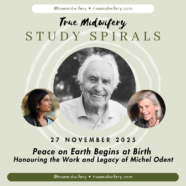
As I prepare for my talk this coming Thursday, Peace on Earth Begins at Birth — Honouring the Work and Legacy of Michel Odent with Ruth Ehrhardt and Clara Scropetta, alongside my friend Clara Scropetta, I am filled with tender emotion.
Read MoreThe Silent Birthkeeper – The Art of Honouring Silence in Birth

“It will take a long time to rediscover the importance of silence and to accept that the dominant quality of a midwife should be her capacity to keep her mouth shut.”— Michel Odent, The Functions of the Orgasms (2009) I laughed out loud when I re-read these words from Michel recently. It felt as though he was shouting from beyond the grave — reminding us again of the impossible simplicity of creating the optimal environment for birth. He is, of course, speaking about the basic needs of the labouring woman, and how to create the ideal conditions for oxytocin to flow freely. Silence, a key component, connects to the understanding that when in labour, stimulating a woman’s neocortex (her thinking brain) will only “wake her” from the primal mammalian state needed for the rich cocktail of hormones to flow — allowing pure physiology to unfold. “You cannot manage an involuntary process, the point is not to disturb it.” Why do I call this an impossible simplicity? Because we humans love to talk. Even if we understand in theory that birth unfolds best in silence, it is difficult in practice. Whether to ask practical questions like: “How long since your waters broke?”“When did labour start?”“How far apart are the contractions?” Or to offer words of comfort like: “You’re doing so well.”“You can do this.” Each of these requires the mother to leave her primal state and re-engage her thinking brain. An important practice of true midwifery is therefore to learn to say little to nothing in the birthing space — unless it is truly required. The Basic Needs of a Woman in Labour To feel safeTo switch off the neocortex (thinking brain)SilenceDarknessNot feeling observedWarmthLow levels of adrenaline When these needs are honoured, the result can be the foetus ejection reflex — the natural, undisturbed unfolding of birth. Michel reminds us: “From a practical perspective we are now in a position to present authentic midwifery as the art of creating the conditions for a foetus ejection reflex.” Why The Silent Birthkeeper? The Silent Birthkeeper is a one-year journey into True Midwifery. It is for those who feel the quiet calling in their bones — who know there is more to birthwork than protocols and procedures, and who long to sit at the edges of birth, holding space with reverence, humility, and trust. Over 12 months, we will walk together through presence, knowledge, and practice — exploring the basic needs, the art of listening, self-care and community care, storytelling, ceremony, and the foundations of midwifery. This is not a course, but a year-long initiation — a space to soften, listen, and remember. Join the Circle The Silent Birthkeeper runs from 5 February 2026 – 11 February 2027.Bookings are now open, with early bird pricing until the end of November. Learn more and book your place...
Read MoreBlossoms, Balance, and the Return of Spring

“Flowers are consciousness celebrating.” — Eckhart Tolle A year ago or so, I decided to tend a little corner of our garden — a patch of earth that was neither beautiful nor beloved. It gets plenty of sun, but it was a “dead spot,” the path we take to hang the laundry and fetch it again. Not a place to linger, just one to pass through. Each time I carried the washing, though, I felt it quietly calling. So I began laying down compost, shaping small beds, and waiting to see what wanted to grow there. Slowly, the ground began to answer. Now, after the winter rains, that forgotten patch is abundant — granadillas climbing, mint spreading its fragrance, strawberries rooting, and flowers opening with joy. A once-neglected place has become a celebration. Yesterday was the Spring Equinox here in the South. As the earth tips back into balance, the sun grows warmer, the birds begin their morning songs, and the blossoms announce the season’s return. It was also a special day in my family: my eldest daughter, my Spring Equinox baby, turned 21. Though she is far away in the North, I reminded her that her birthday always brings sunshine, berries, and flowers. A blessing woven into the rhythm of the season. May this Spring invite you too into renewal — tending forgotten corners, noticing what is ready to bloom, and remembering that balance always returns. A reminder for our True Midwifery Study Spiral with Vera Dubrovina this week Supporting IVF pregnancy and birth25 September 2025 @ 11am – 2pm SAST IVF pregnancy, especially after years of fertility struggles, carries profound layers — blending medical science with ancestral, energetic, and spiritual dimensions. Birth following assisted conception is not only a physical event but also a spiritual alignment, weaving past and future together. In this Study Spiral, Vera will share her observations on why assisted birth and C-sections are so common after IVF, what this reveals, and how to hold these journeys with depth, reverence, and care. Join the Study Spiral...
Read MoreWeaving Birth, Life and Death…

It is nearly two weeks since our dear Michel passed away, and the loss of this incredible human still sits heavy in my heart. The news of Michel’s passing reached me just days after I returned home from a pilgrimage to my own birth land, Switzerland — the place of my earliest years, where I had not been back since my 20th birthday, 25 years ago. I spent time in the home I lived in as a baby, with my god family, in the mountains. The places, smells, and sounds stirred long-forgotten memories — a quiet homecoming of sorts. I stood beneath the trees that were planted when I was a baby and now tower over me, holding their own stories of time passed. Visiting my eldest daughter, who is now living and working very close to where I once lived, was also profoundly connecting. Sharing a landscape familiar to us both, but for our own reasons, felt very special. While there, I had the honour of attending the birth of a beautiful little girl high up in the mountains overlooking a magical lake. Samara and I have been friends and colleagues for over a decade, but this was our first birth together. Joined by Ale, a new midwife friend, we formed a circle of elephants around this birth — weaving a silent, steady web of safety around the birthing mother and her family. Now, back home, I find myself in an integration phase — holding both the tenderness of Michel’s passing and the enormity of my journey. Here in South Africa, spring is beginning to show herself: longer, warmer days and African daisies greeting the sun each morning. I am holding my heart gently as I continue to sit with it all. The enormity of Michel’s legacy sits with me, and many ideas bubble to the surface about how I — and we — can stay true to his work. Yet I also feel the need to honour the fact that he himself is still transitioning, and that he and his family require our quiet holding and respect. Transitions must be honoured with reverence. As I shared in my previous newsletter, Michel repeated one message again and again: every mother and baby require our silence to find one another. “Do not wake the mother!” he would say. In this moment, I feel the same is true for Michel. May we offer him that silence as he crosses over. If you feel called to walk more deeply with these themes of birth, life, and transition, here are some upcoming offerings: Birth First Aid — a global, home birth–friendly learning space for birthkeepers. True Midwifery Study Spiral — with our next session on Supporting IVF Pregnancy and Birth led by Vera Dubrovine, 25 September 2025. Silent Birthkeeper (2026/2027) — add your name to the waiting list to be the first to know when bookings...
Read MoreRemembering my friend Michel…
In all honesty, I have no words to express the loss of my friend, mentor, teacher Michel Odent. At this time I feel I just want to sit in silence to honour his passing…in the same way he encouraged us to do for mother and baby as they transition. I will miss his wisdom, his humility, his endless curiosity, his ability to think outside the box, his constantly challenging us… His sense of humour… May those of us left behind remember and stay true to his work and legacy. May we continue to bring peace to Earth by healing birth on this planet. Go well Michel. Hamba Kahle….* “Hamba kahle” is an isiZulu and isiXhosa phrase meaning “Go well“. It is used as a farewell, often said to someone who is leaving, and it can also be a respectful way to say goodbye to a person who has...
Read More