


For Michel, One Year on…
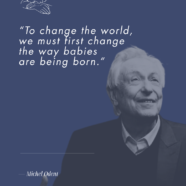
Today marks one year since our dear Michel Odent passed away. “To change the world, we must first change the way babies are being born.” These words are so simple and yet so powerful. So true. Thank you, dear Michel, for dedicating your life to uncovering and rediscovering the source of truth and love. I dont have many words…but I hold a lot of gratitude in my heart. Today I light a candle for you…x
Read MoreWhat does it mean to be a Silent Birthkeeper?
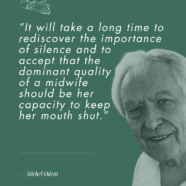
It is nearly a year since my dear teacher, mentor and friend Michel Odent passed away. In the weeks and months after his death, I found myself returning to his books. I remember lying in bed one evening reading The Functions of the Orgasms when I came across these words: “It will take a long time to rediscover the importance of silence and to accept that the dominant quality of a midwife should be her capacity to keep her mouth shut.” I sat up in bed and laughed out loud. It felt so quintessentially Michel. Almost as though he was speaking from beyond the grave and making it very clear that one of the key components of being a trusted guardian of birth is knowing how to be quiet. So much of birth work is focused on doing. What should we do? What should we say? How should we reassure? How should we support? And yet one of the key components of creating an optimal environment for physiology to do her dance may simply be to… as Michel so aptly put it… is to shut up… But silence is about so much more than not talking. Silence also has to do with our internal state. All that chatter we tend to carry around as human beings. Can we sit quietly with ourselves before we attempt to do that for another? When we are in conversation with someone, can we simply listen? Can we be fully present without judgement or criticism, without planning our own response or thinking about what we might say next? Can we open our hearts and simply receive another human being as she is? With, dare I say it, love? Perhaps this is where the practice of being a Silent Birthkeeper begins. Silence is not passivity. A Silent Birthkeeper is not a passive birthkeeper. Nor is she an indifferent one. Nothing could be further from the truth. A Silent Birthkeeper is deeply present. She is attuned to the rhythms, sounds, smells and movements of labour. She understands that for a woman to birth her baby, there is a vital life force that needs to move through her, and that this needs to be protected. Another phrase Michel exclaimed again and again was: “The keyword is protection!” A Silent Birthkeeper is a protector of birth and of the birthing process. She understands, in the words of Liliana Lammers, that: “Birth is a story between two people: the mother and the baby.” And she learns to discern the difference between doing nothing because she is afraid or doesn’t know what to do, and doing nothing because nothing needs to be done. There is an enormous difference. The basic needs are simple. Living them is not. The basic needs of a woman in labour are remarkably simple. And yet they can be surprisingly difficult to protect because, as human beings, we so often want to do. We want to help. Reassure. Rescue. Feel useful. The Silent Birthkeeper asks something else of us. To become deeply attuned while learning to prowl the perimeter of the birthing field as protectors of what is unfolding. Perhaps you are curious about what this looks like in practice. Come and gather with us on 20 August On Thursday 20 August, I am holding a free online information gathering for anyone who feels curious about the Silent Birthkeeper and would like to understand more. We will meet for one hour, from 11:00–12:00 SAST. We will share more about the immersion, how our year together unfolds and what we explore, and there will be space for...
Read MoreTHE BASIC NEEDS OF THE NEWBORN
Listening at the Threshold of Life There is a moment, just after birth, when everything is still tender, open, and profoundly alive. The newborn is adapting to life outside the womb.The mother is adapting to life with her baby in her arms.Both are exquisitely sensitive to their surroundings. How we meet this moment matters. The first hours and days after birth are not simply a time of transition; they are a time of imprinting. What is felt, sensed, and experienced here echoes forward: into bonding, regulation, health, and our capacity to meet the world. When we speak about the basic needs of the newborn, we are not speaking about techniques or protocols. We are speaking about conditions. About atmosphere. About the quality of presence offered around new life. In this reflection, we turn toward a simple yet radical orientation:zero separation and zero interruption. ––––––––– LISTENING THROUGH THE LENS OF MONTESSORI AND ODENT Looking through the lens of Maria Montessori and Michel Odent, we are invited to reconsider what care truly means in the earliest moments of life. Montessori understood that birth and early life must be protected, not managed. She spoke about the newborn as a “spiritual embryo,” a being in a profound state of formation, deeply affected by the environment into which they arrive. Privacy, warmth, continuity, and calm were not luxuries, but basic needs. Michel Odent later articulated this understanding through the language of physiology and Primal Health. He showed how early experiences shape the interaction between the primal brain, the hormonal system, and the immune system: systems that guide us for a lifetime. High levels of stress and interruption in the early hours after birth can have lasting effects on bonding, regulation, and health. Both Montessori and Odent remind us of something quietly challenging:any unnecessary help can become an obstacle. ––––––––– THE NEED FOR SAFETY, SERENITY, AND SILENCE The most fundamental need of the mother and newborn is to feel safe. Safety allows the body to soften.Serenity allows hormones to flow.Silence allows adaptation and bonding to unfold. After birth, both mother and baby are recovering from an immense physiological and emotional passage. They are learning each other. Their senses are heightened. Their nervous systems are open and impressionable. When the space around them is filled with noise, conversation, observation, or subtle interference, energy is pulled outward. When the space is quiet, respectful, and restrained, energy can turn inward: toward healing, connection, and rest. Silence is not emptiness.It is an offering. It allows mother and baby to reconnect after an abrupt separation. From this reconnection, everything else flows. ––––––––– LEARNING WITH KARIN SLABAUGH This work is at the heart of the teaching shared by Karin Slabaugh, who has dedicated her life’s work to studying, guarding, and protecting the newborn. Karin brings together Montessori’s original insights with decades of lived experience and careful observation, bridging traditional wisdom with contemporary understanding. Her work is grounded, humble, and deeply respectful of the newborn as a sensitive, relational being. Karin and I collaborate closely on the Basic Needs of Babies work, and it is a deep honour to walk alongside her in exploring how we meet life at its very beginning. You can learn more about this shared work here:https://www.montessori-for-life.org/the-basic-needs-of-babies/ ––––––––– A QUIET INVITATION When we change how we meet the newborn, we change something fundamental, not only for individual families, but for the wider culture. This reflection is an invitation to listen more closely.To protect the earliest moments of life.And to remember that sometimes the most powerful care we can offer is silence, trust, and reverence. ––––––––– This session is...
Read MoreWhen The Days Feel Full, Go To Nature

When the days feel full, go to nature You should sit in nature 20 minutes every day…Unless you are busy, then you should sit for at least an hour. I have always loved this Zen proverb. It feels simple, almost obvious. And yet, when life gathers momentum, it can be easy to forget. The pull of work, responsibility, and constant communication can draw us into a kind of mental compression. The never-ending hamster wheel of to‑do lists and overflowing inboxes that sometimes feels like opening Pandora’s box. We know we need space, but we tell ourselves we’ll take it later. This week marked my return to work after a month away from my computer, emails, and projects. I was aware, even before opening my laptop, that it might feel like lifting the lid off a bubbling pot of soup, that familiar sense of urgency, the feeling that everything needed attention all at once. Just anticipating it had my nervous system on edge. With it still being summer, and after having spent so much time outdoors over the past month, I decided that before sitting down to work, I would go for a short walk. Nothing ambitious. Just a chance to stretch my legs, walk the dog, and allow my thoughts to arrive gently. That twenty‑minute walk turned into an hour‑long wander down to the bay at low tide… and a spontaneous dip in the ice‑cold Atlantic. Somewhere between the sea air and the shock of cold water, my to‑do list rearranged itself. My body remembered how to settle. My breathing deepened. By the time I returned home and finally opened my computer, I felt resourced rather than overwhelmed. It was a quiet reminder of something I return to again and again in my work: tending to our most basic needs is not optional. It is foundational. Whether we are mothers, birth workers, caregivers, or simply human beings moving through full lives, regulation, safety, and presence are where everything else begins. That morning set the tone for my return and it filled me with renewed excitement for the offerings unfolding within the True Midwifery community. As we begin a new year of Study Spirals, I’m delighted to be welcoming my dear friend and longtime collaborator, Karin Slabaugh, for our first gathering. In this upcoming Study Spiral, we will explore the fundamental needs of the newborn and the delicate unfolding of the mother‑baby relationship in the first hours and days of life. Drawing on the wisdom of Maria Montessori and the insights of Michel Odent, Karin invites us to reflect on how birth and early adaptation shape what is often called Primal Health, the subtle interplay of hormonal, immune, and primal brain systems. Through this lens, we will consider what it means to create environments of zero separation and zero interruption: spaces where the newborn’s deep need for safety and serenity can unfold naturally, and where the quiet presence of attendants allows mother and baby to reconnect and begin life together in peace. If you are interested and would like to learn more about this upcoming spiral, and the programme for 2026 see HERE These reflections are not only about birth. They speak to a wider truth: that life thrives when we slow down, listen closely, and protect the conditions that allow connection to emerge. As I move back into work this year, I’m holding that morning by the sea as a compass. When the days feel full, go to nature.When the mind feels loud, return to the body.And when in doubt, tend first to what is most basic. With...
Read MoreReflections on Our Study Spiral Honouring Michel Odent

Last week’s Study Spiral, Peace on Earth Begins at Birth, was one of those gatherings that quietly settles into the bones. Days later, I am still carrying the tenderness and the sense of profound connection that arose as we came together to honour the life and legacy of Michel Odent, a man whose work has shaped, guided, and challenged so many of us walking the path of True Midwifery. There are moments in this work that feel like thresholds, where something subtle shifts in the collective field. This Spiral felt like one of them. A Visit From Liliana The most moving part of our time together was the presence of Liliana, Michel’s partner in life, birth, and death. With an honesty that was both steady and fragile, she shared a recent birth she attended, a story woven with sensitivity, intuition, and that unmistakable presence of someone who has lived and breathed birth for decades. She also spoke about the tenderness of Michel’s passing, her own grieving, and the intimacy of accompanying someone you have walked beside for so long. Her words did not come as teaching, but as transmission: a kind of living echo of Michel’s essence. We became, without needing to try, a circle of elephants, quietly standing with her, holding her experience, her remembering, and her love. In that moment, the Spiral became what it always hopes to be:a place where wisdom meets humanity, and where our collective holding becomes a form of care. The Lineage of Love and Attention One of Michel’s most important teachings — and one Liliana echoed — is this: “Birth is a story between two people — the mother and the baby.” It’s such a simple sentence. And yet, in a world where birth has become increasingly technologised, politicised, and crowded with opinions, this truth feels more radical than ever. The mother.The baby.Two nervous systems finding each other.Two bodies completing an ancient dance. Everything else is secondary. Our Spiral felt like a return to that simplicity, not in a nostalgic way, but in a deeply embodied, grounded way. A remembering of what is actually essential. Continuing Michel’s Care After the session, I reached out to thank Liliana and asked whether there was a charity or cause that reflected Michel’s values, something to which we could donate the proceeds of the gathering. Her answer surprised me with its sweetness. She told me that Michel had always been especially protective of the birds and squirrels in their neighbourhood in London. Feeding them was a daily ritual of kindness. She still continues this small act on his behalf. She suggested we donate to London Wildlife Protection, a local organisation that cares for urban wildlife. And so, in honour of Michel, that is exactly what we will do. I find something beautiful in this:that our Spiral community, gathered in his name, will help feed the birds and squirrels he loved. A simple, humble continuation of his care. An Invitation Into Our Final Spiral of 2025 As we close this year of Study Spirals, a year rich with learning, remembering, and returning to the roots of our craft, we have one final gathering remaining. And it is a special one. Closing the Bones with Jodi Jade In December, we welcome Jodi Jade, who will guide us into the lineage, history, and deeper purpose of the Traditional Mexican Closing of the Bones ceremony. This Spiral will be an exploration of: the origins of the Rebozothe wisdom of rites of passagehow ritual restores what modern life often fracturesthe variations and deep healing potential of Closing the Bonesand the essential elements of postpartum care and community holding It feels like...
Read More