


Last Week we Gathered to Chat About Home Birth

We do this every three months here in Cape Town, in a lovely home in the seaside village of Muizenberg. Lana and I have been running these gatherings for the last five years. They were born out of a need and a desperation to provide support and information to those seeking direction and advice around this obscure birthing option and the gatherings have gained a momentum of their own. When we first started them we would work so hard to spread the word, posting flyers to all the midwives and interested antenatal teachers. We would arrange speakers and explore themes. We would advertise and spread the word and we would always lose money running them but loved it and loved the responses and stories we got. They were always worth it. And then something shifted. The gatherings grew. And so did the stories. And the variety and range of people who came. It has become such a safe space to listen and share. Mothers, fathers, doulas, midwives, interested parties attend and all seem to leave humbled and moved. As do we. Every time. Mothers share their birthing experiences, their eyes still glowing with oxytocin. These women, these strong strong women, share what made them feel strong and empowered. They share their vulnerable and beautiful stories to a hungry audience, an audience who needs affirmation and support in the choices they are making. “Stories teach us in ways we can remember. They teach us that each woman responds to birth in her unique way and how very wide-ranging that way can be. Sometimes they teach us about silly practices once widely held that were finally discarded. They teach us the occasional difference between accepted medical knowledge and the real bodily experiences that women have – including those that are never reported in medical textbooks nor admitted as possibilities in the medical world. They also demonstrate the mind/body connection in a way that medical studies cannot. Birth stories told by women who were active participants in giving birth often express a good deal of practical wisdom, inspiration, and information for other women. Positive stories shared by women who have had wonderful childbirth experiences are an irreplaceable way to transmit knowledge of a woman’s true capacities in pregnancy and birth.” – Ina May Gaskin I feel honoured and blessed to be part of these gatherings every three months. I do wish we could run them more often but for now, every three months will have to do. Thanks again to all who come and share....
Read MoreDo we Need More Midwives in South Africa?

Apparently, if you call up the South African Nursing Council (SANC) (under which all registered South African midwives must fall) then you will be told that there is a long list of registered midwives in South Africa – their database seems to reflect an adequate amount of trained and registered midwives. Midwives are known to improve the outcomes of births and yet here in South Africa, our maternal mortality rates do not reflect this. Since the Millenium Development Goals were set in 1990, with decreasing maternal mortality by 75% by 2015 being one of the goals, South Africa’s maternal mortality have risen. If you scratch below the surface, you will discover that South African midwifery training at present requires four years of nursing which includes only six months of midwifery. There is an option to study Advanced Midwifery at university level after qualifying as a midwife and some midwives may choose to go this route. What essentially happens, is that many nurses are trained who can call themselves midwives, are registered and listed as midwives, and can work as midwives but who may not choose to work as midwives, or who feel no particular compassion for the pregnant and labouring women they serve, or may not have a passion or drive for midwifery. And even if they do feel passionate about midwifery, they often feel inadequately equipped to work in the settings they are placed in after qualifying. Some Facebook support groups have sprung up for midwives in South Africa and they have grown as a place for midwives to voice their fears and concerns, as well as a place for them to share stories and information.When I see that midwives are too afraid to work in the labour ward – I feel that our midwifery education system has failed them. Jason Marcus and Jenna Morgan, both midwifery educators in South Africa, refer to the current South African midwifery training as ‘the fruit salad’ and both feel strongly that South Africa needs to look at the needs of our pregnant population and meet those needs through our midwifery training. At present, both feel that those needs are not being properly looked at and, therefore, are not being met. When I hear stories of abuse in South African maternity wards, from mothers, medical students, midwives, doulas and through the media (and I have witnessed it on numerous occasions), then I know that something vital is missing. That we are failing pregnant and labouring women. Last year, I sat with a support group of mothers from SWEAT (Sex Workers Education and Advocacy Taskforce) and discovered that out of about ten of the mothers present, four had chosen to give birth at home unassisted, some because of precipitous labour, but primarily because it felt easier and safer to give birth alone than to be mistreated and shunned. And when they called me a couple of weeks later to let me know that a first time single mother, who lived under a bridge and survived as a sex worker, had died whilst trying to birth on her own under that bridge, I knew our maternity system had failed her. When I drive past Red Hill informal settlement and I give lifts to the women who are hitch-hiking to have their antenatal check-ups, or to take their sick babies to the clinic and I hear the stories of how many women avoid those antenatal checks, or don’t even book at the hospital, and try to arrive at the hospital as late as possible, or not at all, because it is too far, or too tedious or because of how...
Read MoreIt was at a Home Birth That I Learned to fry an egg Properly

It was at a home birth that I learned to fry an egg properly. Sunny side up. The yolk not quite runny but not hard either. Somewhere inbetween. Heat the pan, add the oil (coconut oil was used in this case I think), crack the eggs into the pan. Sizzle sizzle. Crackle crackle. Pop pop. Then cover the pan with a lid and turn off the heat. This was served on toast smeared with avocado and cracked pepper and salt. At the same home birth I also weeded the garden in the sun. It was at a home birth that I first learned to follow the lead of the cat. I learned the patience to sit in the garden while the sun set silently and the new mother found her rhythm. It was at a home birth that I found out that birth is unpredictable and that midwives need to think quickly on their feet and that they need the necessary skills, to deal with the rare emergencies that present themselves, burned into their muscle memories. It was at a home birth that I learned what excellent reflexes I had when a baby bungie jumped without warning out of her mother as her mother waddled across the kitchen floor. It was at a home birth that I learned that labour can rock to any tune and that a mother may roar to Linkin Park at full blast, sigh to Miles Davis accompanied by the soft splashes of the birth pool, or swing and twist her hips like a snake,to Ravi Shankar, evoking images of a belly dancer. It was also at a home birth that I learned that Dr. Phil could even be suitable background music. It was at a home birth that I learned to master knitting a sock. And at the next home birth I very nearly finished the pair. It was at a home birth that I sat with a wide eyed little girl on my lap as we looked at her vernix covered sister for the first time. It was also at a home birth that I saw a five year old boy reach out his hand as his sister’s head emerged – he was the first one to touch his sister. He gasped in amazement. It was at a home birth that I learned to draw the curtains and turn off the lights. And to keep my mouth...
Read MoreHome birth as a trend?

All good things must come to a trend, so obviously, home birth in all its fabulousness is going to have to come to the forefront, especially with rumours flying around that the future queen of England, Kate Middleton, is possibly planning a home birth (which I believe to be untrue). But what is it about home birth that is attracting more and more South African women to this particular option? Lana Petersen and I have been running Home Birth South Africa for the last 5 years – something we started purely out of frustration because there was nowhere that a South African woman could go for information on this birthing option – i.e. there was a lot of information available online and in books on home birth but all in the UK, the USA and Australia and nothing which made it seems like a tangible and doable concept within the South African context. So, Home Birth South Africa has been going for the last five years, running quarterly gatherings and information sessions – a place where those interested in home birth, planning a home birth, have had a home birth, wanted one but didn’t get to have one, doulas, midwives, birth activists and those generally interested and who support it can gather to share, ask questions and discuss. The gatherings took place for a long time at Erin Hall in Rondebosch but these days take place at Norman and Jenny Skillen’s rock star mansion in Muizenberg. We usually gather in a circle and each person shares who they are and why they are there, they might share a story and ask some questions. Discussion inevitably ensues and we usually go over time. Over the years, the gatherings have grown in momentum and yesterday’s event attracted nearly forty people to it. Our website and data base grew out of the home birth gatherings when we realised that the need for information and stories needed to be available on a national level. The website gives information, answers questions, provides stories written and shared by South African mothers and families, and offers a directory of home birth friendly practitioners – we are always on the look out for more stories, contributions, information so please feel free to share by contacting us. Stories can be published anonymously. So what is it about home birth and why are we so passionate about it? In this article with photographer Leah Hawker we touch on what drives both Lana and me but I think to summarise, for both Lana and myself it is not home birth per se which is our agenda but being able to provide information and knowledge to women and their families that helps them tap into their own needs around birthing their babies. And both of us are in awe of women when that certain something is unlocked in labour and the new raging, power of that woman is opened as she finds a new part of herself. Innately women seem to want to give birth where they feel safest and most comfortable, and within the South African health care system, while medically very sound, that feeling of safety, of feeling cared for, of being nurtured, of being heard and valued, is so often not there. (And no, there are not really any midwife run birth centres for those women seeking the middle ground.) Not sure when it happened that healthy pregnant women were considered ‘sick’ and deemed only fit to birth in hospital and not sure how it happened that women accepted that this would be the norm. But what I do see are that...
Read MoreHelping Babies Breathe
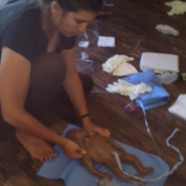
Helping Babies Breathe (HBB) is an initiative of the American Academy of Paediatrics and the World Health Organisation. It is a programme that has been implemented to ensure that every birth attendant is skilled in the basics of neonatal resuscitation as part of one of the five 2015 Millennium Goals (to reduce infant mortality). Apparently, in Countries where this programme has been implemented, governments have found a decrease of up to 25% in neonatal deaths. Helping Babies Breathe is a neonatal resuscitation curriculum for resource-limited circumstances. It was developed on the premise that assessment at birth and simple newborn care are things that every baby deserves. The initial steps taught in HBB can save lives and give a much better start to many babies who struggle to breathe at birth. The focus is to meet the needs of every baby born. Helping Babies Breathe emphasises skilled attendants at birth, assessment of every baby, skin to skin contact with mother, delayed cord clamping, temperature support, stimulation to breathe, and assisted ventilation as needed, all within “The Golden Minute” after birth. Midwife Marianne Littlejohn and myself are trained as teachers and trainers of HBB and volunteer for Operation Smile and have thus far taught midwives, doctors, NICU staff, nurses, doulas, birth attendants, mothers, fathers, and interested people these basic but life saving skills. We have been privileged to teach all over South Africa, as well as in Malawi and Kenya. Plans are also afoot for us to teach in the DRC and Lesotho, as well as continuing to teach in South Africa. This last week I taught the skills to a group of peers, WOMBS doulas and CPM Mandi Busson at friend and colleague Lana Petersen‘s home. I must admit to feeling slightly intimidated, teaching friends and colleagues but this fell away very quickly as stories were shared and we acted out various scenarios from precipitous unplanned home births to water births. What I love about the HBB programme is its emphasis on normal birth – that it reiterates that approximately 90% of all births are straightforward and that it teaches as its introduction how to facilitate that: Skin to skin, delayed cord clamping, breastfeeding, etc and that even when a baby needs help to breathe, that every step is take to ensure that that mother and baby bond and cycle is not broken. Here are some pictures from this week’s course. We had so much fun acting out the various scenarios that plans are afoot for some fun birth theatre sports, possibly to be presented at this year’s Cape Town Midwifery and Birth Conference. If you would like to host or attend a Helping Babies Breathe course, please contact...
Read More