


Fire

I cannot write without somehow paying tribute the fire that ravaged the mountains of Cape Town this last week and the men and women who worked tirelessly to fight the flames and save the homes, families and animals affected. I also want to extend my condolences to the families of Nazeem Davies and Bees Marais…I am very sorry for your loss. Mountain fires are a way of life here in Cape Town and we all accept and expect them in a way at this time of the year, when it is dry and the South Easter blows, but I think we have to agree that the fires this last week affected us on a grand scale and seemed relentless. On Tuesday night, after that very very hot day, I lay in bed listening as the wind picked up and I was sure I could smell smoke through my open window. I went outside, it was about two in the morning, and I saw many lights on in many of the houses. I think many Scarbarians were also listening and waiting attentively. A vague orange glow seemed to be coming from over the mountain. I went back inside and went online to try and find out what was going on and saw via Twitter and Facebook the streams of posts and photos regarding the fires in Noordhoek, Kalk Bay, Muizenberg, Clovelly, Tokai, Hout Bay and Constantia. Friends were evacuating their homes and the fire seemed out of control. I felt quite helpless watching these posts on my stream and my own memories around being evacuated when there was a fire here in Scarborough seven years ago were evoked. In 2008, when I was 38 weeks pregnant with my youngest daughter, a fire ripped through Scarborough, burning homes. I was visiting a friend here in the village with my children on the day for an afternoon play but it soon became evident that staying put was not a good idea. The fire seemed to be advancing very quickly and had already engulfed some homes, the mountain was ablaze and Scarborough filled with smoke. We went down to the beach where we also slowly became smoked out, it eventually became difficult to breathe. There we were, two mothers, on the beach, no car (her husband was up the mountain fighting the flames, mine was playing a concert – he is a musician) , with 5 children, one of us pregnant, getting smoked out. Eventually we were spotted by a sympathetic paramedic who drove us to Kommetjie where we ate pizzas with our sooty faced children until family and friends could come and collect us. That evening we could return to Scarborough and thankfully neither of our homes had burnt down – although other friends were not as lucky. But I remember the thin trickle of black dust that seemed to rain down on us after that, covering everything. Around two weeks later, I gave birth to a sweet baby girl – Kaira, after 4 hours of labour, at home. Life goes on, I...
Read MoreHome birth as a trend?

All good things must come to a trend, so obviously, home birth in all its fabulousness is going to have to come to the forefront, especially with rumours flying around that the future queen of England, Kate Middleton, is possibly planning a home birth (which I believe to be untrue). But what is it about home birth that is attracting more and more South African women to this particular option? Lana Petersen and I have been running Home Birth South Africa for the last 5 years – something we started purely out of frustration because there was nowhere that a South African woman could go for information on this birthing option – i.e. there was a lot of information available online and in books on home birth but all in the UK, the USA and Australia and nothing which made it seems like a tangible and doable concept within the South African context. So, Home Birth South Africa has been going for the last five years, running quarterly gatherings and information sessions – a place where those interested in home birth, planning a home birth, have had a home birth, wanted one but didn’t get to have one, doulas, midwives, birth activists and those generally interested and who support it can gather to share, ask questions and discuss. The gatherings took place for a long time at Erin Hall in Rondebosch but these days take place at Norman and Jenny Skillen’s rock star mansion in Muizenberg. We usually gather in a circle and each person shares who they are and why they are there, they might share a story and ask some questions. Discussion inevitably ensues and we usually go over time. Over the years, the gatherings have grown in momentum and yesterday’s event attracted nearly forty people to it. Our website and data base grew out of the home birth gatherings when we realised that the need for information and stories needed to be available on a national level. The website gives information, answers questions, provides stories written and shared by South African mothers and families, and offers a directory of home birth friendly practitioners – we are always on the look out for more stories, contributions, information so please feel free to share by contacting us. Stories can be published anonymously. So what is it about home birth and why are we so passionate about it? In this article with photographer Leah Hawker we touch on what drives both Lana and me but I think to summarise, for both Lana and myself it is not home birth per se which is our agenda but being able to provide information and knowledge to women and their families that helps them tap into their own needs around birthing their babies. And both of us are in awe of women when that certain something is unlocked in labour and the new raging, power of that woman is opened as she finds a new part of herself. Innately women seem to want to give birth where they feel safest and most comfortable, and within the South African health care system, while medically very sound, that feeling of safety, of feeling cared for, of being nurtured, of being heard and valued, is so often not there. (And no, there are not really any midwife run birth centres for those women seeking the middle ground.) Not sure when it happened that healthy pregnant women were considered ‘sick’ and deemed only fit to birth in hospital and not sure how it happened that women accepted that this would be the norm. But what I do see are that...
Read MoreHelping Babies Breathe
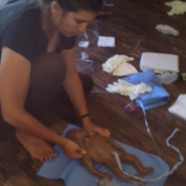
Helping Babies Breathe (HBB) is an initiative of the American Academy of Paediatrics and the World Health Organisation. It is a programme that has been implemented to ensure that every birth attendant is skilled in the basics of neonatal resuscitation as part of one of the five 2015 Millennium Goals (to reduce infant mortality). Apparently, in Countries where this programme has been implemented, governments have found a decrease of up to 25% in neonatal deaths. Helping Babies Breathe is a neonatal resuscitation curriculum for resource-limited circumstances. It was developed on the premise that assessment at birth and simple newborn care are things that every baby deserves. The initial steps taught in HBB can save lives and give a much better start to many babies who struggle to breathe at birth. The focus is to meet the needs of every baby born. Helping Babies Breathe emphasises skilled attendants at birth, assessment of every baby, skin to skin contact with mother, delayed cord clamping, temperature support, stimulation to breathe, and assisted ventilation as needed, all within “The Golden Minute” after birth. Midwife Marianne Littlejohn and myself are trained as teachers and trainers of HBB and volunteer for Operation Smile and have thus far taught midwives, doctors, NICU staff, nurses, doulas, birth attendants, mothers, fathers, and interested people these basic but life saving skills. We have been privileged to teach all over South Africa, as well as in Malawi and Kenya. Plans are also afoot for us to teach in the DRC and Lesotho, as well as continuing to teach in South Africa. This last week I taught the skills to a group of peers, WOMBS doulas and CPM Mandi Busson at friend and colleague Lana Petersen‘s home. I must admit to feeling slightly intimidated, teaching friends and colleagues but this fell away very quickly as stories were shared and we acted out various scenarios from precipitous unplanned home births to water births. What I love about the HBB programme is its emphasis on normal birth – that it reiterates that approximately 90% of all births are straightforward and that it teaches as its introduction how to facilitate that: Skin to skin, delayed cord clamping, breastfeeding, etc and that even when a baby needs help to breathe, that every step is take to ensure that that mother and baby bond and cycle is not broken. Here are some pictures from this week’s course. We had so much fun acting out the various scenarios that plans are afoot for some fun birth theatre sports, possibly to be presented at this year’s Cape Town Midwifery and Birth Conference. If you would like to host or attend a Helping Babies Breathe course, please contact...
Read MoreWhat is it About Birth?

What is it about birth? It is as though time suspends itself and something unique unfolds from within the labouring woman. She has purred, sighed, breathed, whimpered, cried her way through her contractions, these life giving pains which make her rock her hips, make her moan and groan, make her eyes roll back in her head, make her sweat, make her hate, make her angry, make her one, make her have to give in, give up, surrender. And as she surrenders something primal is unlocked and this, this essence, this power takes over, her body is no longer her own. She sits on the loo, or she squats, or she kneels, or she lies on her side.She grunts and moans, red slime drips down her thighs, she feels overwhelmed. She may stand up, she may look up, she may feel with her hand as the head of the baby slowly stretches her perineum. She seems more alert now. There. Present. She may crouch down, or breathe, or gasp, or moan, or scream as her baby’s head emerges, not quite believing the sensation of this slimy little head stretching stretching stretching her wide open. The head emerges and hangs, almost lifeless. The world holds its breath. Then a splutter, or a crackle, or a bubble of spittle and a grimace. Then slowly, slowly, the baby’s head turns – as though ready to face the world and with a newfound power, the little body ejects itself, swimming forth in a gush of blood and water and shit. Again, it is as though time has suspended itself as the baby, still aquatic in its features and colour, begins to move, sometimes throwing its arms back and stretching its back like a ballet dancer, and sometimes uncurling slowly slowly slowly as though waking from a deep sleep. A gurgle, a crackle, a soft cry. Slippery body, oily white vernix, blinking eyes, stretching fingers and toes. Cord pulsating. Body breathing. Mother touching. Stroking. Smelling. Kissing. Whispering. Crying. Laughing. Grateful. Astonished. Astounded. Holding. Loving. Ecstatic. Triumphant. Perfect. Beautiful. Primal. Sublime. What is it about birth?...
Read MoreAre We Creating an Epidemic of High-Risk Women?

Two weeks ago I wrote about the first unnecessary caesar I attended. It was the first but it was also not the last. It did prompt me to do my homework and to really make sure that the women I was attending as a doula were well informed. One of the things I did was call up all the maternity wards of all the private hospitals here in Cape Town and ask them directly what their their caesarean section rates were. I knew from discussions with other doulas and midwives that many caesars were taking place but I did not have clear numbers. The conversations went something like this: “Hi…I am a doula supporting mothers wanting to birth vaginally in private hospitals here in Cape Town and I would just like to know what your caesarean rates are so that they can make an informed decision about where the best possible place to birth is.” Or something along those lines. Responses were everything from helpful and obliging to irritated, rude and irate: “Oh one doctor here has about a 60% caesar rate…he really tries, but the others are definitely around 80 – 90%” “About 65% but I think it is the private midwives that do deliveries here that bring the rates down…the doctors have much higher rates than that.” “Between 60 and 90%.” “I don’t see why we should divulge this sort of information, I don’t see how a high caesarean rate can make a difference to a woman’s chances to birth naturally!” “It is definitely upward of 80% but I am not telling you how much higher – I don’t think it is any of your business!” So in private hospitals in Cape Town, we are looking at a caesarean rate of 60 – 90%. And from my experience in two of the major government hospitals in Cape Town, it seems to be around 50% in the public sector. The World Health Organisation recommended a caesar rate of between 10 – 15% as being healthy, so WHY is our caesarean section rate so high? And why is it not my business to find out the caesarean rate of a hospital that is often promising to be supportive of women’s wishes to birth as they wished? And why is it suddenly okay to slice open perfectly healthy women and change their obstetric history forever? (I need to stress that I am not anti caesarean. I am eternally grateful for the operation that saves the lives of mothers and babies. I am not putting down this very necessary intervention and the skilled people who can perform it.) Since then I have worked within home birth midwifery practices and met midwives from all over the world who maintain a caesarean rate of between 2 and 20 %. Why do they get it right and the hospitals do not? I think the saddest and hardest thing for me is meeting the women who have undergone these unnecessary caesars. Who come with their stories. And who really want to give birth vaginally this time around, sometimes after one, sometimes after two, sometimes after more caesareans… I was induced at 38 weeks and didn’t progress so I had to have a caesar. The doctor said my baby was getting to big and I would never be able to birth her – but then she was an average size! I had a supportive doctor but she was on holiday when I went into labour and I got the doctor with the highest caesar rate in the hospital. The environment was too clinical for me, the beeping machines,...
Read MoreBirth : A Poem

Birth: What is birth? Birth is the emergence of a new individual from the body of it’s mother. The emergence of that new individual, is the emergence of a new life. Birth is completely normal yet unbelievably profound. As that baby emerges, everyone holds their breath….. Where do we give birth? We choose to have our babies in various settings: At home In hospital In a theatre And sometimes these are not choices but necessities. Sometimes we plan to give birth in one way but then something completely different may happen. Sometimes babies are born in trees, or on trains or by the roadside. Sometimes babies choose for themselves where they want to be born. Where and how we give birth affects who we are. It affects how we are as parents. We need to feel safe. We need to feel confident. And we need to feel in control, so that later we can lose control. If a woman feels cared for and nurtured, she is more likely to love and care for her baby. When we feel safe where we give birth, we give birth more easily. If we feel frightened or vulnerable, we may feel traumatised and incapable of loving our babies. If we are made to believe that we are incapable, we may hand over the power to someone else. There is a hidden secret in our culture: ‘It is not that birth is painful It is that women are...
Read More