


What does it mean to be a Silent Birthkeeper?
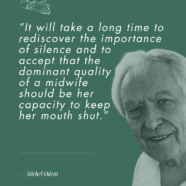
It is nearly a year since my dear teacher, mentor and friend Michel Odent passed away. In the weeks and months after his death, I found myself returning to his books. I remember lying in bed one evening reading The Functions of the Orgasms when I came across these words: “It will take a long time to rediscover the importance of silence and to accept that the dominant quality of a midwife should be her capacity to keep her mouth shut.” I sat up in bed and laughed out loud. It felt so quintessentially Michel. Almost as though he was speaking from beyond the grave and making it very clear that one of the key components of being a trusted guardian of birth is knowing how to be quiet. So much of birth work is focused on doing. What should we do? What should we say? How should we reassure? How should we support? And yet one of the key components of creating an optimal environment for physiology to do her dance may simply be to… as Michel so aptly put it… is to shut up… But silence is about so much more than not talking. Silence also has to do with our internal state. All that chatter we tend to carry around as human beings. Can we sit quietly with ourselves before we attempt to do that for another? When we are in conversation with someone, can we simply listen? Can we be fully present without judgement or criticism, without planning our own response or thinking about what we might say next? Can we open our hearts and simply receive another human being as she is? With, dare I say it, love? Perhaps this is where the practice of being a Silent Birthkeeper begins. Silence is not passivity. A Silent Birthkeeper is not a passive birthkeeper. Nor is she an indifferent one. Nothing could be further from the truth. A Silent Birthkeeper is deeply present. She is attuned to the rhythms, sounds, smells and movements of labour. She understands that for a woman to birth her baby, there is a vital life force that needs to move through her, and that this needs to be protected. Another phrase Michel exclaimed again and again was: “The keyword is protection!” A Silent Birthkeeper is a protector of birth and of the birthing process. She understands, in the words of Liliana Lammers, that: “Birth is a story between two people: the mother and the baby.” And she learns to discern the difference between doing nothing because she is afraid or doesn’t know what to do, and doing nothing because nothing needs to be done. There is an enormous difference. The basic needs are simple. Living them is not. The basic needs of a woman in labour are remarkably simple. And yet they can be surprisingly difficult to protect because, as human beings, we so often want to do. We want to help. Reassure. Rescue. Feel useful. The Silent Birthkeeper asks something else of us. To become deeply attuned while learning to prowl the perimeter of the birthing field as protectors of what is unfolding. Perhaps you are curious about what this looks like in practice. Come and gather with us on 20 August On Thursday 20 August, I am holding a free online information gathering for anyone who feels curious about the Silent Birthkeeper and would like to understand more. We will meet for one hour, from 11:00–12:00 SAST. We will share more about the immersion, how our year together unfolds and what we explore, and there will be space for...
Read MoreThe Silent Birthkeeper – The Art of Honouring Silence in Birth

“It will take a long time to rediscover the importance of silence and to accept that the dominant quality of a midwife should be her capacity to keep her mouth shut.”— Michel Odent, The Functions of the Orgasms (2009) I laughed out loud when I re-read these words from Michel recently. It felt as though he was shouting from beyond the grave — reminding us again of the impossible simplicity of creating the optimal environment for birth. He is, of course, speaking about the basic needs of the labouring woman, and how to create the ideal conditions for oxytocin to flow freely. Silence, a key component, connects to the understanding that when in labour, stimulating a woman’s neocortex (her thinking brain) will only “wake her” from the primal mammalian state needed for the rich cocktail of hormones to flow — allowing pure physiology to unfold. “You cannot manage an involuntary process, the point is not to disturb it.” Why do I call this an impossible simplicity? Because we humans love to talk. Even if we understand in theory that birth unfolds best in silence, it is difficult in practice. Whether to ask practical questions like: “How long since your waters broke?”“When did labour start?”“How far apart are the contractions?” Or to offer words of comfort like: “You’re doing so well.”“You can do this.” Each of these requires the mother to leave her primal state and re-engage her thinking brain. An important practice of true midwifery is therefore to learn to say little to nothing in the birthing space — unless it is truly required. The Basic Needs of a Woman in Labour To feel safeTo switch off the neocortex (thinking brain)SilenceDarknessNot feeling observedWarmthLow levels of adrenaline When these needs are honoured, the result can be the foetus ejection reflex — the natural, undisturbed unfolding of birth. Michel reminds us: “From a practical perspective we are now in a position to present authentic midwifery as the art of creating the conditions for a foetus ejection reflex.” Why The Silent Birthkeeper? The Silent Birthkeeper is a one-year journey into True Midwifery. It is for those who feel the quiet calling in their bones — who know there is more to birthwork than protocols and procedures, and who long to sit at the edges of birth, holding space with reverence, humility, and trust. Over 12 months, we will walk together through presence, knowledge, and practice — exploring the basic needs, the art of listening, self-care and community care, storytelling, ceremony, and the foundations of midwifery. This is not a course, but a year-long initiation — a space to soften, listen, and remember. Join the Circle The Silent Birthkeeper runs from 5 February 2026 – 11 February 2027.Bookings are now open, with early bird pricing until the end of November. Learn more and book your place...
Read More