


What does it mean to be a Silent Birthkeeper?
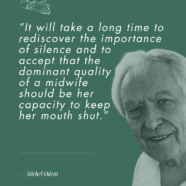
It is nearly a year since my dear teacher, mentor and friend Michel Odent passed away. In the weeks and months after his death, I found myself returning to his books. I remember lying in bed one evening reading The Functions of the Orgasms when I came across these words: “It will take a long time to rediscover the importance of silence and to accept that the dominant quality of a midwife should be her capacity to keep her mouth shut.” I sat up in bed and laughed out loud. It felt so quintessentially Michel. Almost as though he was speaking from beyond the grave and making it very clear that one of the key components of being a trusted guardian of birth is knowing how to be quiet. So much of birth work is focused on doing. What should we do? What should we say? How should we reassure? How should we support? And yet one of the key components of creating an optimal environment for physiology to do her dance may simply be to… as Michel so aptly put it… is to shut up… But silence is about so much more than not talking. Silence also has to do with our internal state. All that chatter we tend to carry around as human beings. Can we sit quietly with ourselves before we attempt to do that for another? When we are in conversation with someone, can we simply listen? Can we be fully present without judgement or criticism, without planning our own response or thinking about what we might say next? Can we open our hearts and simply receive another human being as she is? With, dare I say it, love? Perhaps this is where the practice of being a Silent Birthkeeper begins. Silence is not passivity. A Silent Birthkeeper is not a passive birthkeeper. Nor is she an indifferent one. Nothing could be further from the truth. A Silent Birthkeeper is deeply present. She is attuned to the rhythms, sounds, smells and movements of labour. She understands that for a woman to birth her baby, there is a vital life force that needs to move through her, and that this needs to be protected. Another phrase Michel exclaimed again and again was: “The keyword is protection!” A Silent Birthkeeper is a protector of birth and of the birthing process. She understands, in the words of Liliana Lammers, that: “Birth is a story between two people: the mother and the baby.” And she learns to discern the difference between doing nothing because she is afraid or doesn’t know what to do, and doing nothing because nothing needs to be done. There is an enormous difference. The basic needs are simple. Living them is not. The basic needs of a woman in labour are remarkably simple. And yet they can be surprisingly difficult to protect because, as human beings, we so often want to do. We want to help. Reassure. Rescue. Feel useful. The Silent Birthkeeper asks something else of us. To become deeply attuned while learning to prowl the perimeter of the birthing field as protectors of what is unfolding. Perhaps you are curious about what this looks like in practice. Come and gather with us on 20 August On Thursday 20 August, I am holding a free online information gathering for anyone who feels curious about the Silent Birthkeeper and would like to understand more. We will meet for one hour, from 11:00–12:00 SAST. We will share more about the immersion, how our year together unfolds and what we explore, and there will be space for...
Read MoreSeasons of a Birthkeeper

When birth work was first ignited in me, I was a young woman entering my own childbearing years. I was learning about pregnancy, birth and motherhood not only through books and teachers, but through my own body and through my own babies. My children and my work grew alongside one another. The seasons of my family and the seasons of my work became deeply intertwined. Now, almost three decades later, something feels different. My children are grown. They are young adults making their own way in the world. They are now around the age that I was when I was becoming a mother myself. As I look at them, I realise that I, too, am standing at the threshold of a new season. Not yet a grandmother, perhaps, but certainly no longer the young mother who first stepped onto this path. This week I also quietly moved into inactive status with my professional midwifery certification. It was not a decision made in a moment. Like many decisions that matter, it unfolded over time. There were practical realities, changing requirements, and many months of trying to find a way forward. But alongside all of that was a growing sense of acceptance. Sometimes life gently asks us to pause, not because we are giving up, but because we are being invited to listen more deeply. Although there is definitely an aspect of experiencing the loss of something I worked hard to achieve, it also feels like an opportunity to stop for a while and ask a different question. Who am I, in relation to birth, in this season of my life? For many years I have cared deeply about building bridges between different worlds. I have been grateful to study and work within traditional, academic and medical spaces. Each has taught me something valuable. Each has helped me understand birth from a different perspective. I have appreciated being able to move between those worlds, and I remain deeply thankful for the opportunities my professional certification has opened for me. But over recent years I have also found myself reflecting on something else. Can the deepest work of birth ever be fully held by institutions? Not because institutions are without value. They have an important role. Good legislation can protect women. Education can deepen understanding. Professional standards can help create safer care. Yet the healing of birth itself begins elsewhere. It begins in homes. In quiet rooms. In relationships. With women and with babies. In communities willing to sit beside one another with humility, love and presence. I don’t know whether I will return to active certification. I don’t know what new forms this work may take. Birth has taught me many things over the years. One of the greatest has been that life cannot always be forced into our timelines. There are moments for action. And there are moments for waiting. There are seasons for pushing. And there are seasons for allowing something new to gather itself before it enters the world. Perhaps this is one of those seasons. And for now, that feels like that is...
Read MoreThe Silent Birthkeeper – The Art of Honouring Silence in Birth

“It will take a long time to rediscover the importance of silence and to accept that the dominant quality of a midwife should be her capacity to keep her mouth shut.”— Michel Odent, The Functions of the Orgasms (2009) I laughed out loud when I re-read these words from Michel recently. It felt as though he was shouting from beyond the grave — reminding us again of the impossible simplicity of creating the optimal environment for birth. He is, of course, speaking about the basic needs of the labouring woman, and how to create the ideal conditions for oxytocin to flow freely. Silence, a key component, connects to the understanding that when in labour, stimulating a woman’s neocortex (her thinking brain) will only “wake her” from the primal mammalian state needed for the rich cocktail of hormones to flow — allowing pure physiology to unfold. “You cannot manage an involuntary process, the point is not to disturb it.” Why do I call this an impossible simplicity? Because we humans love to talk. Even if we understand in theory that birth unfolds best in silence, it is difficult in practice. Whether to ask practical questions like: “How long since your waters broke?”“When did labour start?”“How far apart are the contractions?” Or to offer words of comfort like: “You’re doing so well.”“You can do this.” Each of these requires the mother to leave her primal state and re-engage her thinking brain. An important practice of true midwifery is therefore to learn to say little to nothing in the birthing space — unless it is truly required. The Basic Needs of a Woman in Labour To feel safeTo switch off the neocortex (thinking brain)SilenceDarknessNot feeling observedWarmthLow levels of adrenaline When these needs are honoured, the result can be the foetus ejection reflex — the natural, undisturbed unfolding of birth. Michel reminds us: “From a practical perspective we are now in a position to present authentic midwifery as the art of creating the conditions for a foetus ejection reflex.” Why The Silent Birthkeeper? The Silent Birthkeeper is a one-year journey into True Midwifery. It is for those who feel the quiet calling in their bones — who know there is more to birthwork than protocols and procedures, and who long to sit at the edges of birth, holding space with reverence, humility, and trust. Over 12 months, we will walk together through presence, knowledge, and practice — exploring the basic needs, the art of listening, self-care and community care, storytelling, ceremony, and the foundations of midwifery. This is not a course, but a year-long initiation — a space to soften, listen, and remember. Join the Circle The Silent Birthkeeper runs from 5 February 2026 – 11 February 2027.Bookings are now open, with early bird pricing until the end of November. Learn more and book your place...
Read MoreWhat Does It Mean to Be a Midwife Today?
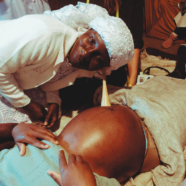
I’ve been travelling and mostly unplugged these past weeks, but I keep dipping back into the True Midwifery online community to feel its pulse. And every time, I’m reminded how rare it is to find a space that runs on love, trust, and discernment. It’s not that we all agree. Far from it. We come from different trainings, traditions, and ways of working. But there’s a deep respect for one another’s paths — and in the birth world, that’s something precious. Lately, our upcoming Study Spiral has stirred up some big feelings for me around the topic of modern-day witch hunts. And I keep coming back to this: so often, they are about women not trusting each other. Turning on each other to feel safe, or to keep our footing in a system that doesn’t truly support us. In birth work, it’s the same old pattern — patriarchy’s favourite trick: divide and rule. The Splintering of Our Roles One way this shows up is in the way we’ve created countless “safe” titles so we can be allowed to serve mothers and babies. Birthkeeper. Doula. Traditional Birth Attendant. Once, all of these roles were simply what it meant to be a midwife — a person who stood beside the mother and baby through the threshold of birth. Now, we’ve been split and split and split again. With every division, we’re more restricted, more regulated, more over-specialised… and less able to offer the full, holistic care mothers and babies actually need. A Lesson from the Anamaboya I was reminded of this when I sat with the Anamaboya — the traditional Shona midwives in Zimbabwe. I shared with them the different titles we see nowadays, and they looked at me with quiet confusion, as if I’d just asked for a different word for love, or for water. “What do you call yourselves?” I asked. “Anamaboya,” they said simply. Midwife. Grandmother. Their qualification? Being called to the work by God. A dream.Their gift? Deep humility. Trust in birth. A willingness to learn. The knowledge that their true work is to love the mother. Who Decides? Not long ago, an empirical midwife I met offered me a definition I’ve been holding close: A midwife is a midwife when recognised as such by her community. It’s such a simple sentence, and yet it pulls at so many threads — identity, authority, recognition, belonging. For me, this is not about deciding on one definition. It’s about opening the conversation and letting the questions breathe: Who gets to decide what a midwife is?How does language include… and exclude?And how might our own divisions be keeping us from serving mothers and babies as fully as we could? I’d love to explore these questions together in our upcoming Study Spiral. With love,Ruth Join this month’s Spiral → true-midwifery1.teachable.com/p/true-midwifery-study-spirals Last Spot in the Birth First Aid Course (starting 2...
Read MoreComing Back to the Simple

A heartfelt reflection on birth, physiology, and the wisdom shared by Michel Odent and Liliana Lammers. Coming back to the simple in True Midwifery.
Read More