


What does it mean to be a Silent Birthkeeper?
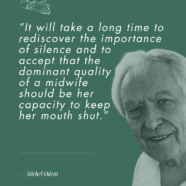
It is nearly a year since my dear teacher, mentor and friend Michel Odent passed away. In the weeks and months after his death, I found myself returning to his books. I remember lying in bed one evening reading The Functions of the Orgasms when I came across these words: “It will take a long time to rediscover the importance of silence and to accept that the dominant quality of a midwife should be her capacity to keep her mouth shut.” I sat up in bed and laughed out loud. It felt so quintessentially Michel. Almost as though he was speaking from beyond the grave and making it very clear that one of the key components of being a trusted guardian of birth is knowing how to be quiet. So much of birth work is focused on doing. What should we do? What should we say? How should we reassure? How should we support? And yet one of the key components of creating an optimal environment for physiology to do her dance may simply be to… as Michel so aptly put it… is to shut up… But silence is about so much more than not talking. Silence also has to do with our internal state. All that chatter we tend to carry around as human beings. Can we sit quietly with ourselves before we attempt to do that for another? When we are in conversation with someone, can we simply listen? Can we be fully present without judgement or criticism, without planning our own response or thinking about what we might say next? Can we open our hearts and simply receive another human being as she is? With, dare I say it, love? Perhaps this is where the practice of being a Silent Birthkeeper begins. Silence is not passivity. A Silent Birthkeeper is not a passive birthkeeper. Nor is she an indifferent one. Nothing could be further from the truth. A Silent Birthkeeper is deeply present. She is attuned to the rhythms, sounds, smells and movements of labour. She understands that for a woman to birth her baby, there is a vital life force that needs to move through her, and that this needs to be protected. Another phrase Michel exclaimed again and again was: “The keyword is protection!” A Silent Birthkeeper is a protector of birth and of the birthing process. She understands, in the words of Liliana Lammers, that: “Birth is a story between two people: the mother and the baby.” And she learns to discern the difference between doing nothing because she is afraid or doesn’t know what to do, and doing nothing because nothing needs to be done. There is an enormous difference. The basic needs are simple. Living them is not. The basic needs of a woman in labour are remarkably simple. And yet they can be surprisingly difficult to protect because, as human beings, we so often want to do. We want to help. Reassure. Rescue. Feel useful. The Silent Birthkeeper asks something else of us. To become deeply attuned while learning to prowl the perimeter of the birthing field as protectors of what is unfolding. Perhaps you are curious about what this looks like in practice. Come and gather with us on 20 August On Thursday 20 August, I am holding a free online information gathering for anyone who feels curious about the Silent Birthkeeper and would like to understand more. We will meet for one hour, from 11:00–12:00 SAST. We will share more about the immersion, how our year together unfolds and what we explore, and there will be space for...
Read MoreRemembering my friend Michel…
In all honesty, I have no words to express the loss of my friend, mentor, teacher Michel Odent. At this time I feel I just want to sit in silence to honour his passing…in the same way he encouraged us to do for mother and baby as they transition. I will miss his wisdom, his humility, his endless curiosity, his ability to think outside the box, his constantly challenging us… His sense of humour… May those of us left behind remember and stay true to his work and legacy. May we continue to bring peace to Earth by healing birth on this planet. Go well Michel. Hamba Kahle….* “Hamba kahle” is an isiZulu and isiXhosa phrase meaning “Go well“. It is used as a farewell, often said to someone who is leaving, and it can also be a respectful way to say goodbye to a person who has...
Read MoreReturning to the Source: Sitting Again with my Mentors in Birth

Fifteen years ago, as a student midwife and doula, I was beginning to question my place in the world of birth work. Though the language of “trusting birth” was everywhere, the practices I witnessed told a different story. Coaching, managing, intervening—whether subtle or overt—seemed baked into even the most “natural” birth environments. I felt uneasy, isolated, and uncertain. At that time, I found myself drawn again to the writings of Michel Odent. His words gave shape to something I instinctively felt but couldn’t yet articulate: that birth, as an involuntary process, cannot be helped—only protected. I searched to see if he had written anything about doulas and discovered something unexpected: a doula course in London, taught by Michel and a woman named Liliana Lammers. It was happening just days before I was due to attend a birth in Edinburgh. I changed my travel plans. Those three days became a turning point in my life. I remember the feeling of finding my teachers—my mentors. Sitting in circle with Michel and Liliana, I experienced a kind of cellular realignment. Their presence, their stories, their science, their reverence for undisturbed birth helped clarify and confirm everything I had been feeling. It was like being handed a compass. That experience birthed something else too: my book, The Basic Needs of a Woman in Labour, was a direct attempt to capture and share the essence of what I received from them. Over the years, I’ve had the honour of reconnecting with them—teaching alongside Michel, attending their online courses, and most recently, sitting with them in person again in Amsterdam. But now, with Michel having just turned 95, and his public teaching naturally becoming more rare, each opportunity to sit at their feet feels even more precious. This weekend, I’ll be supporting the upcoming Paramana Doula Course, and I’m filled with both reverence and joy. It’s open to anyone who wishes to protect and honour the physiological process of birth—from doulas to midwives to anyone called to this path. Whether you are just beginning or coming full circle, I warmly invite you to join us. Paramana Doula CourseWith Michel Odent and Liliana Lammers12–14 July 2025 | OnlineRecordings available for all participants True Midwifery community members receive a 10% discount.To book: moonfeather7@gmail.com | +44 7443 656855 And as a gift to honour this return, my book The Basic Needs of a Woman in Labour will be available as a free Kindle download during the course dates (12–14 July):https://mybook.to/basicneedsENG With love and trust in the birth...
Read MoreWhy Birth First Aid?

The First Time I Ever Resuscitated a Baby on my own I remember the first time I had to resuscitate a baby on my own. It had been a fairly average first labour. It started in the middle of the night and trotted along into the new day. The mother was surprised at the intensity of the surges but she rode them quietly and stoically. The emergence of the baby was slow and as her mother crouched, she was born gently onto the floor onto a soft pile of towels. Some mothers scoop their babies up immediately, while others take their time, looking, smelling, and touching. Still, others need to take their time, first processing the enormity of the event before being able to look and engage. As long as the space is warm and the mother and baby are left undisturbed all are variations of normal. In this case, the mother was slow to interact with her baby, I believe she was initially taken aback at the sight of her newborn. It became evident that this baby was not responding after being born, not showing much muscle tone and not breathing. Helping Babies Breathe I had recently been trained in the Helping Babies Breathe (HBB) programme as a facilitator through Operation Smile and worked as a volunteer for some of their educational missions in Africa. What I love about this programme is its simplicity: its focus on normal birth, preparedness, its understanding for working in low-resourced and out-of-hospital settings, as well as the all important MotherBaby needs like skin-to-skin and not cutting the umbilical cord. As a skilled birth attendant, you make a difference In the HBB programme, we are taught that the majority of babies are totally fine at birth and require little more than skin-to-skin contact with their mother – but that around 10% require gentle assistance in transitioning from womb life. These are some of the skills we will be focusing on in the upcoming Birth First Aid series of workshops that I will be offering for the month of November. Extreme neonatal resuscitation is rare in healthy pregnancies and births and usually is an indicator of some other underlying issue. Why Birth First Aid? If we are attending births on a regular basis, especially when a birth is left to unfold as it should, we come into contact with the beauty and simplicity that is birth and we receive the regular imprint that birth works and that birth is safe. But every once in a while, nature throws us a curve ball, and in the same way as we expect someone who works with children to be prepared if a child chokes, we want to be prepared for those rare times when a mother or baby does require assistance. In the case of the birth I was describing at the beginning of this post/letter – it felt clear that this baby was struggling. Muscle memory from my HBB training kicked in, and with her cord still attached and intact, between her mother’s legs on the floor, we worked together to gently remind her that she needed to breathe. And she did… I invite you to join us We will be gathering weekly for the month of November on these dates: 2, 9, 16, and 23 November 2022 via zoom from 11am – 2pm SAST (GMT+2) COST: 130 Euro / 130 USD / 1250 ZAR All sessions will be recorded and made available to you for one month after the call For more information or to book your place please email me at truemidwife@gmail.com What we will cover over...
Read MoreWhen you sit with a woman in labour, allow yourself to become soft…

Notice yourself. Your own breathing. Allow it to become deep. Allow it to become soft. When you sit with a woman in labour notice yourself. Your body. Your breathing. Sit quietly in a corner. Or lie down. Avert your gaze. Droop your head as though in prayer. Close your eyes as though in meditation or sleep. Or make your eyes soft soft soft and look at nothing on the ground. Allow your breath to become deep and expansive; fill your lungs, your rib cage, your entire being. Allow your breath to become deep and expansive like the waves of the ocean. In and out. In and out. Become so huge that your arms embrace the room, the world, the universe. Hold the woman in labour in an unseen embrace. Become so huge and expansive that you disappear into nothingness. Stay with your breath. Your softness. And the soft sighs and moans of the woman in...
Read More