


Seasons of a Birthkeeper

When birth work was first ignited in me, I was a young woman entering my own childbearing years. I was learning about pregnancy, birth and motherhood not only through books and teachers, but through my own body and through my own babies. My children and my work grew alongside one another. The seasons of my family and the seasons of my work became deeply intertwined. Now, almost three decades later, something feels different. My children are grown. They are young adults making their own way in the world. They are now around the age that I was when I was becoming a mother myself. As I look at them, I realise that I, too, am standing at the threshold of a new season. Not yet a grandmother, perhaps, but certainly no longer the young mother who first stepped onto this path. This week I also quietly moved into inactive status with my professional midwifery certification. It was not a decision made in a moment. Like many decisions that matter, it unfolded over time. There were practical realities, changing requirements, and many months of trying to find a way forward. But alongside all of that was a growing sense of acceptance. Sometimes life gently asks us to pause, not because we are giving up, but because we are being invited to listen more deeply. Although there is definitely an aspect of experiencing the loss of something I worked hard to achieve, it also feels like an opportunity to stop for a while and ask a different question. Who am I, in relation to birth, in this season of my life? For many years I have cared deeply about building bridges between different worlds. I have been grateful to study and work within traditional, academic and medical spaces. Each has taught me something valuable. Each has helped me understand birth from a different perspective. I have appreciated being able to move between those worlds, and I remain deeply thankful for the opportunities my professional certification has opened for me. But over recent years I have also found myself reflecting on something else. Can the deepest work of birth ever be fully held by institutions? Not because institutions are without value. They have an important role. Good legislation can protect women. Education can deepen understanding. Professional standards can help create safer care. Yet the healing of birth itself begins elsewhere. It begins in homes. In quiet rooms. In relationships. With women and with babies. In communities willing to sit beside one another with humility, love and presence. I don’t know whether I will return to active certification. I don’t know what new forms this work may take. Birth has taught me many things over the years. One of the greatest has been that life cannot always be forced into our timelines. There are moments for action. And there are moments for waiting. There are seasons for pushing. And there are seasons for allowing something new to gather itself before it enters the world. Perhaps this is one of those seasons. And for now, that feels like that is...
Read MoreHelping Babies Breathe
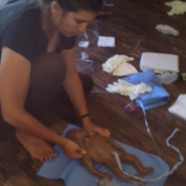
Helping Babies Breathe (HBB) is an initiative of the American Academy of Paediatrics and the World Health Organisation. It is a programme that has been implemented to ensure that every birth attendant is skilled in the basics of neonatal resuscitation as part of one of the five 2015 Millennium Goals (to reduce infant mortality). Apparently, in Countries where this programme has been implemented, governments have found a decrease of up to 25% in neonatal deaths. Helping Babies Breathe is a neonatal resuscitation curriculum for resource-limited circumstances. It was developed on the premise that assessment at birth and simple newborn care are things that every baby deserves. The initial steps taught in HBB can save lives and give a much better start to many babies who struggle to breathe at birth. The focus is to meet the needs of every baby born. Helping Babies Breathe emphasises skilled attendants at birth, assessment of every baby, skin to skin contact with mother, delayed cord clamping, temperature support, stimulation to breathe, and assisted ventilation as needed, all within “The Golden Minute” after birth. Midwife Marianne Littlejohn and myself are trained as teachers and trainers of HBB and volunteer for Operation Smile and have thus far taught midwives, doctors, NICU staff, nurses, doulas, birth attendants, mothers, fathers, and interested people these basic but life saving skills. We have been privileged to teach all over South Africa, as well as in Malawi and Kenya. Plans are also afoot for us to teach in the DRC and Lesotho, as well as continuing to teach in South Africa. This last week I taught the skills to a group of peers, WOMBS doulas and CPM Mandi Busson at friend and colleague Lana Petersen‘s home. I must admit to feeling slightly intimidated, teaching friends and colleagues but this fell away very quickly as stories were shared and we acted out various scenarios from precipitous unplanned home births to water births. What I love about the HBB programme is its emphasis on normal birth – that it reiterates that approximately 90% of all births are straightforward and that it teaches as its introduction how to facilitate that: Skin to skin, delayed cord clamping, breastfeeding, etc and that even when a baby needs help to breathe, that every step is take to ensure that that mother and baby bond and cycle is not broken. Here are some pictures from this week’s course. We had so much fun acting out the various scenarios that plans are afoot for some fun birth theatre sports, possibly to be presented at this year’s Cape Town Midwifery and Birth Conference. If you would like to host or attend a Helping Babies Breathe course, please contact...
Read More