


What does it mean to be a Silent Birthkeeper?
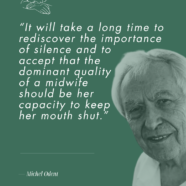
It is nearly a year since my dear teacher, mentor and friend Michel Odent passed away. In the weeks and months after his death, I found myself returning to his books. I remember lying in bed one evening reading The Functions of the Orgasms when I came across these words: “It will take a long time to rediscover the importance of silence and to accept that the dominant quality of a midwife should be her capacity to keep her mouth shut.” I sat up in bed and laughed out loud. It felt so quintessentially Michel. Almost as though he was speaking from beyond the grave and making it very clear that one of the key components of being a trusted guardian of birth is knowing how to be quiet. So much of birth work is focused on doing. What should we do? What should we say? How should we reassure? How should we support? And yet one of the key components of creating an optimal environment for physiology to do her dance may simply be to… as Michel so aptly put it… is to shut up… But silence is about so much more than not talking. Silence also has to do with our internal state. All that chatter we tend to carry around as human beings. Can we sit quietly with ourselves before we attempt to do that for another? When we are in conversation with someone, can we simply listen? Can we be fully present without judgement or criticism, without planning our own response or thinking about what we might say next? Can we open our hearts and simply receive another human being as she is? With, dare I say it, love? Perhaps this is where the practice of being a Silent Birthkeeper begins. Silence is not passivity. A Silent Birthkeeper is not a passive birthkeeper. Nor is she an indifferent one. Nothing could be further from the truth. A Silent Birthkeeper is deeply present. She is attuned to the rhythms, sounds, smells and movements of labour. She understands that for a woman to birth her baby, there is a vital life force that needs to move through her, and that this needs to be protected. Another phrase Michel exclaimed again and again was: “The keyword is protection!” A Silent Birthkeeper is a protector of birth and of the birthing process. She understands, in the words of Liliana Lammers, that: “Birth is a story between two people: the mother and the baby.” And she learns to discern the difference between doing nothing because she is afraid or doesn’t know what to do, and doing nothing because nothing needs to be done. There is an enormous difference. The basic needs are simple. Living them is not. The basic needs of a woman in labour are remarkably simple. And yet they can be surprisingly difficult to protect because, as human beings, we so often want to do. We want to help. Reassure. Rescue. Feel useful. The Silent Birthkeeper asks something else of us. To become deeply attuned while learning to prowl the perimeter of the birthing field as protectors of what is unfolding. Perhaps you are curious about what this looks like in practice. Come and gather with us on 20 August On Thursday 20 August, I am holding a free online information gathering for anyone who feels curious about the Silent Birthkeeper and would like to understand more. We will meet for one hour, from 11:00–12:00 SAST. We will share more about the immersion, how our year together unfolds and what we explore, and there will be space for...
Read MoreClosing the Bones of 2025, Opening the Spiral of 2026

As this year draws to a close, I find myself reflecting on what it has meant to move through 2025 together, not just in content, but in relationship, presence, and shared inquiry. Our final Study Spiral of the year, Closing of the Bones & Honouring Lineage, arrived as a fitting threshold. It felt like a conscious closing of the bones of the year itself, an invitation to gather what has been lived, learned, and felt across the Study Spirals, and to allow it to settle. Closing of the Bones is an ancient rite found in many cultures, most widely recognised through Latin American traditions and the use of the rebozo. In our final gathering, we explored it not as a technique, but as a rite of passage, one that supports integration after birth, loss, illness, initiation, or profound life change. A central thread of the session, and of the year as a whole, has been lineage and integrity. We reflected on the responsibility that comes with receiving and passing on ancestral knowledge, and on how ancient wisdom can live in modern contexts without losing its soul. As the spiral widened, we spoke about rites of passage across the lifespan and the deep human need to be witnessed and held in community. What emerged clearly was this understanding: these thresholds are not meant to be walked alone. As I close the bones of 2025, I feel deep gratitude for this community, for the way it continues to flourish, nourish, and grow with each spiral. Thank you for the depth, care, and presence you bring. At the same time, I am quietly delighted to be opening the next turning of the spiral. The 2026 True Midwifery Study Spirals The 2026 Study Spirals will unfold as thirteen monthly gatherings held across the year. Together we will explore newborn care, reproductive health, birth justice and legal terrain, grief and creativity, elderhood, herbs, freebirth, and the reclamation of midwifery, always held within an intentional, respectful, global container. You can view the full 2026 schedule and details here:https://true-midwifery1.teachable.com/p/true-midwifery-study-spirals-2026 As we move toward the solstice and the festive season, True Midwifery will be entering a summer pause from 19 December to 19 January, honouring the seasonal rhythm here in South Africa. I am trusting this time of rest and integration, and looking forward to returning in the new year, ready to gather...
Read More